


News, Views, and Updates from TERI


Dear Reader,
November was a month defined by action. We successfully bridged the gap between global policy and local implementation—from strengthening our presence at COP 30 in Belém to hosting the AISAC 2025 conference and concluding our multi-state Bio-Methanation workshops. This unique blend of international advocacy and grassroots engagement has generated significant momentum, which TERI is excited to channel into high-impact solutions this December.
TERI @ COP30

At COP30, TERI represented India’s leadership in sustainable development, elevating vital perspectives from the Global South. Through research and partnerships, the institute drove the transition toward low-carbon, climate-resilient growth. Aligning with COP30’s themes of adaptation, renewable energy, and sustainable food systems, TERI advocated for equitable climate finance and championed resilient infrastructure planning. The organization also prioritized capacity building and policy advocacy grounded in scientific principles. By bridging global ambition with local action, TERI successfully translated India’s sustainability vision into transformative pathways for both people and the planet, reaffirming its commitment to a just future.
Know MoreAISAC 2025

The two-day international conference, ‘Agri-Inputs for Sustainable Agriculture and Climate’ (AISAC-2025), hosted by TERI’s Sustainable Agriculture Division at TERI Gram during November 12 to 13, focused on the research & development, policies & protocols, and brainstormed about strategically important nano (fertilizers and pesticides) and biological (biofertilizers, biostimulants, biopesticides) agri-inputs to enhance agricultural and environmental sustainability. The conference provided a stimulating international platform to deliberate about the delicate rhythm and living connection of Agriculture and Climate.
Know MoreCapacity Building and Awareness Generation workshop on Organic Bio-Methanation (Biogas) and its applications

TERI under the GEF - MNRE - UNIDO Project, organised the “Capacity Building and Awareness Generation Workshops on Organic Bio-Methanation (Biogas) and its Applications” for banks, financial institutions, biogas/CBG plant developers, and other relevant stakeholders as part of a series of nine one-day training programmes conducted across India in cities including Lucknow, Chandigarh, Pune, Bengaluru, Bhopal, Ahmedabad, Delhi, Guwahati, and Hyderabad.
Know More
Re-anchoring CBDR-RC in Human Development and SDGs for Climate Justice
This paper examines the interlinkages between human development and energy consumption to operationalise CBDR-RC in the contemporary context. It proposes an energy-consumption- and Human Development Index (HDI)-based zoning framework as a tool for applying CBDR-RC in practice and argues for a renewed multilateral compact that bridges the gap between the Sustainable Development Goals (SDGs) and global climate objectives.
Know More
Hydrogen Rotary Kilns for Ironmaking in India
The paper, ‘Hydrogen Rotary Kilns for Ironmaking in India: A novel solution for decarbonizing small-scale ironmaking,’ outlines a promising technological route for this segment of the industry. In this study, TERI assesses a range of internationally developing low-emission options, identifying the hydrogen rotary kiln as the best fit for the Indian context.
Know More
BIPV in Action: Global Climate Case Study Compendium
TERI, under the consortium of the International Solar Alliance (ISA), University of Applied Sciences and Arts of Southern Switzerland (SUPSI), Arconsol, and Sunappeal, developed a Global Climate Case Study Compendium on Building-Integrated Photovoltaics (BIPV), unveiled at COP30. This landmark publication showcases real-world BIPV projects across diverse climate zones, offering insights into design, technology, and policy innovations for sustainable urban energy transitions.
Know More
Strengthening Multilateralism on the Road to COP33 and Beyond
This paper outlines a reform agenda aimed at restoring urgency, credibility, and trust in the Conference of the Parties (COP) process. Drawing on institutionalist theories, it presents a framework that integrates design dimensions with the core functions of international organizations. The analytical framework applies five key variables—scope, membership, decision-making, functions, and form— to assess the institutional architecture of the United Nations Framework Convention on Climate Change (UNFCCC).
Know MoreCOP30: From Paris pledge to Belem bargain
The challenge in mobilizing $1.3 trillion lies not only in government commitments but also in ensuring that international capital from financial markets becomes accessible at lower costs, writes Mr R R Rashmi, Distinguished Fellow, Resource Efficiency and Governance Division, TERI.
Know MoreCOP30: Who is the enemy of real progress?
Countries who oppose financial ambition are the true adversaries of development at COP30. They are not merely postponing negotiations; they are jeopardizing lives and livelihoods throughout the Global South, writes Dr Manish Kumar Shrivastava, Associate Director, Earth Science and Climate Change Division, TERI.
Know MoreWhat the youth demand from COP 30
The participation of the younger generation in the economies of India’s coal dependent regions is constrained by a complex set of challenges, write Mr Jay Ganesh Pandey and Ms Arpita Elisheba Victor, Research Associate, Electricity & Renewables Division, TERI.
Know More
BRICS Must Support Global South To Keep UNFCCC Alive
Countries who oppose financial ambition are the true adversaries of development at COP30. They are not merely postponing negotiations; they are jeopardizing lives and livelihoods throughout the Global South, writes Dr Manish Kumar Shrivastava, Associate Director, Earth Science and Climate Change Division, TERI.
Know MoreForest Pathshaala: Adivasi Children and the Ecologies of Knowledge

Adivasi children are educated through immersion into their environments and their landscapes. Further, this acquired knowledge tends to be complex ecological knowledge – it is no easy feat to predict seasonal weather, track wild elephant herds, or engage orally with intergenerational history, writes Aryaman Tewari in his article for the TERI Web Desk.
View AllFinancing Forest Landscape Restoration (FLR) under RECAP4NDC

The roundtable conference, jointly organized by TERI and CBI, brought together a wide spectrum of stakeholders, including policy and regulatory bodies, financial institutions, development partners, industry and private sector platforms, legal and consulting partners, conservation and technical organizations, and project implementers and facilitators.
Know MoreBuilding a Forestry Carbon Credit Roadmap for Uttarakhand under RECAP4NDC

TERI and GIZ India, and the Uttarakhand Forest Department jointly organised a 1 day workshop on “Building a Forestry Carbon Credit Roadmap for Uttarakhand" under the RECAP4NDC project. The workshop engaged forest officials and stakeholders to build a strategic understanding of carbon markets under Forest Landscape Restoration (FLR).
Watch HereWorld Sustainable Transport Day - From Carbon to Clean: Transforming Transport for Tomorrow

The webinar brought together experts from transport policy, air quality science, urban planning, and community behavioural change to discuss the link between transport emissions and air pollution (and hence health impacts). They also discussed innovative transport strategies (electric mobility, public transit, shared mobility, freight optimization) that also deliver cleaner air.
Read MoreTAKE 3
Take 3 is a short video featuring in-house experts who answer three pertinent questions on current issues.
Driving Climate Action TERI @ COP30

What does COP 30 truly mean for the world? In this special edition of TAKE 3, Mr Arupendra Mullick, Director, TERI, breaks down the significance of this major global climate conference in this special edition of TAKE 3. He talks about its global relevance and, most importantly, sheds light on India's indispensable role in shaping the future of international climate policy.
Watch HereAQI: What are you Breathing?

Is the air outside safe to breathe right now? And what about indoors? Are there invisible pollutants that could be harming your health. In this edition of TAKE 3, Dr Anju Goel, Associate Director, Centre of Air Quality Research, breaks down exactly what AQI numbers mean and how to use them to protect yourself and your family.
Watch HereCountdown to COP30: India’s Climate Journey | Mr RR Rashmi

As the world prepares for COP30 in Belém, Brazil, The Earth Pod brings you an insightful conversation with Mr RR Rashmi, Distinguished Fellow, TERI, and India’s former Principal Negotiator for Climate Change at the UNFCCC. From India’s remarkable progress on its NDCs and the rollout of a domestic carbon market to the critical issues of equity, finance, and South–South cooperation — this episode unpacks how India is shaping its net-zero pathway and global climate leadership.
Watch HereRising Ambition: India’s Pathways to Net Zero| Mr Ajay Shankar

In this special episode of The Earth Pod, we feature Mr Ajay Shankar, Distinguished Fellow, TERI and one of India’s foremost experts on industrial policy and energy transition. Drawing insights from his new book titled, Rising Ambition: Carving New Pathways — India’s Energy Transition, Mr Shankar reflects on India’s remarkable energy journey.
Watch HerePartner with us for the Silver Jubilee Edition of WSDS
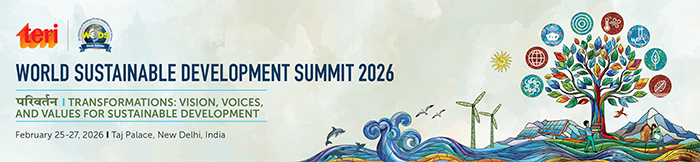
You can engage with the Summit in the following four ways:
1. Partner with Us
WSDS follows a pooled partnership model where partners contribute financially and intellectually to co-create the Summit agenda.
👉 Express your interest to partner: Click here
2. Join as an International Delegate
Apply to attend WSDS 2026 and engage with global leaders, innovators, and ecosystem actors driving sustainability transformation.
👉 Apply to attend: Click here
3. Join as a National Delegate
Be part of a global premier sustainability platform. Apply to attend WSDS 2026 and interact with policymakers, leaders, and practitioners shaping sustainable futures.
👉 Apply to attend: Click here
4. Speak at WSDS 2026
TERI invites nominations for CXO-level speakers — with a special focus on women leaders and voices from both developed and developing countries.
👉 Nominate your CXO: Click here
TERI (The Energy and Resources Institute)
Darbari Seth Block, Core 6C, India Habitat Centre, Lodhi Road,
New Delhi - 110 003, INDIA
Tel. : (+91 11) 2468 2100, 7110 2100
E-mail : mailbox@teri.res.in