TUGD participated in the Urban-Act Regional Synthesis Workshop held in Bangkok on 23–24 February 2026, marking the final module of the two-year regional training programme. The workshop brought together city representatives and partner organisations to consolidate learnings on governance, SDG localisation, climate finance, GEDSI, and spatial planning, while strengthening the practical application of tools such as data disaggregation and project preparation. The engagement also facilitated peer learning and cross-country exchange, helping cities refine climate-responsive project proposals and improve readiness for climate finance. It further provided a platform to assess progress since programme inception and identify pathways for scaling impact. Discussions also focused on aligning city-level actions with global agendas, including upcoming platforms such as COP31, reinforcing continued regional collaboration.
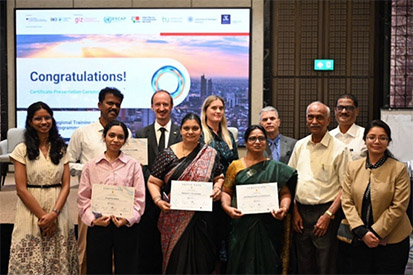
TUGD participated in the Urban-Act regional synthesis workshop.
|
| |
| TUGD Participates in Urban Disaster Risk Resilience (UDRR) Training Programme in Chhattisgarh |
|
TUGD participated in a two-day Urban Disaster Risk Resilience (UDRR) Training Programme held on 21–22 January 2026 in Chhattisgarh. Ms Shiren Pandita, Associate Fellow, TERI, was invited as a speaker and delivered a session titled “From Risk Diagnosis to Resilience Action.” The programme, a first-of-its-kind state-level initiative, focused on strengthening risk-informed urban governance and was anchored around the UNDRR Disaster Resilience Scorecard for Cities under the Making Cities Resilient 2030 (MCR2030) framework. During the session, she highlighted the role of climate risk assessments, spatial data, and Urban Living Labs in translating diagnostic insights into implementable, locally grounded resilience actions embedded within planning and institutional systems. The programme brought together key stakeholders including representatives from NDMA, UNDRR, ADPC, and state and city-level agencies, contributing to advancing institutional capacity for disaster-resilient urban development.
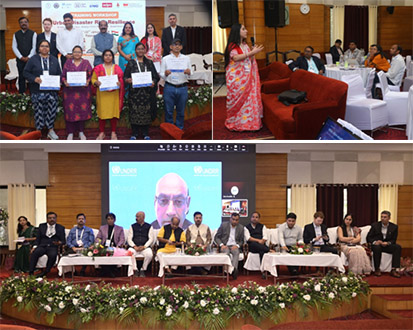
TUGD at the Urban Disaster Risk Resilience (UDRR) Training workshop
|
| |
| TUGD Contributes to Thematic Tracks at WSDS 2026 |
|
TUGD contributed to two thematic tracks at the World Sustainable Development Summit (WSDS) 2026 held on 25 February 2026, focusing on critical aspects of sustainable transport and logistics. The division anchored discussions on “Partnerships for Accelerating EV Skilling Ecosystem in India” and “Green Ports as a Gateway to Decarbonization,” bringing together stakeholders from government, industry, academia, and international organisations.
The session on EV skilling, organised in collaboration with Mercedes-Benz Research and Development India (MBRDI), focused on strengthening India’s workforce ecosystem to support the clean mobility transition. Discussions highlighted the need for industry-aligned skilling frameworks, innovative partnerships, and financing mechanisms to build a future-ready EV workforce. Mr Sharif Qamar, Associate Director, TERI, moderated the session, which saw participation from key ministries, skill councils, and industry representatives.
The thematic track on green ports examined the evolving role of ports in India’s decarbonisation journey, particularly as the maritime sector expands in response to growing trade and industrial activity. The session emphasised the need to integrate environmental considerations into port planning and operations and explored pathways for reducing emissions across port-led logistics and energy systems.
The discussions collectively underscored the importance of integrated approaches spanning skilling, infrastructure, and policy to enable a low-carbon transition in both transport and logistics sectors.
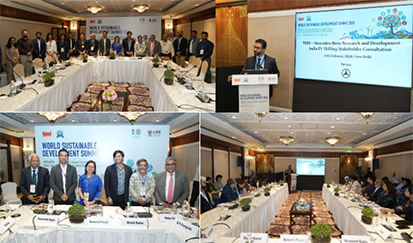
TUGD at WSDS 2026
|
|
| |
| TUGD Supports Electric Vehicle Procurement at Naroda GIDC, Ahmedabad |
|
TUGD supported the process of electric vehicle procurement at Naroda GIDC in Ahmedabad on 11 March 2026, as part of its ongoing project ‘Transition Roadmap for Sustainable and Efficient Transport for GIDC Naroda’. The project focuses on facilitating the transition from conventional internal combustion engine (ICE) vehicles to electric vehicles within industrial estates, which are significant contributors to freight and employee transport emissions.
The engagement involved working closely with stakeholders including industrial units, local authorities, and implementation partners to assess mobility demand, identify suitable vehicle segments, and support procurement planning. The initiative aims to demonstrate scalable pathways for electrification within industrial clusters, where logistics and workforce mobility play a critical role.
As a part of this, Naroda Industries Association (NIA) recently procured two electric vehicles for maintenance and upkeep of the industrial estate. One hydraulic solid waste collection vehicle and one commercial vehicle for maintenance activities were procured. The procurement at Naroda GIDC represents an important step towards enabling low-carbon industrial ecosystems and offers a replicable model for similar industrial areas across India.
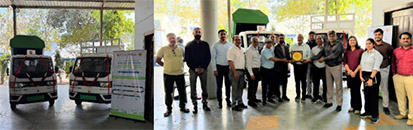
TUGD supported the EV procurement at Naroda GIDC.
For more details about the project visit-
teriin.org/project/roadmap-sustainable-efficient-transport-gidc-naroda
|
|
| |
| TUGD Presents Gap Assessment and GHG Inventory Findings in Thoothukudi |
|
TUGD presented findings from the gap assessment and baseline GHG emission inventory in Thoothukudi, Tamil Nadu, on 7 January 2026, under the UK PACT-supported Digi-PULSE programme. The session, held at the Thoothukudi City Municipal Corporation (TCMC), was attended by the Mayor, Commissioner, and city officials.
The presentation highlighted key data gaps, sectoral emissions particularly from passenger and freight transport and priority areas for intervention. Discussions focused on strengthening data systems, advancing climate-responsive urban planning, and identifying pathways for low-carbon mobility and infrastructure. The visit also included site observations and stakeholder engagement, supporting ongoing work on climate finance and implementation strategies to guide Thoothukudi’s transition toward sustainable urban development.
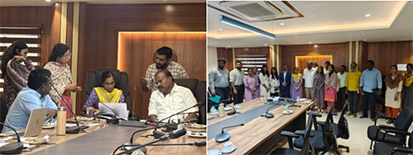
TUGD team presenting Gap assessment and GHG emission inventory to the Thoothukudi Mayor and Commissioner.
|
| |
|
TUGD Co-hosts a Half-Day Event on Freight Emissions Accounting in New Delhi |
|
TUGD, in collaboration with Smart Freight Centre (SFC) India and the Indian Institute of Management (IIM) Bangalore, co-hosted a half-day event on freight emissions accounting and reporting on 10 February 2026 in New Delhi. The event brought together representatives from government agencies, logistics companies, industry bodies, and research organisations to deliberate on approaches for measuring and reducing emissions in the freight sector.
The discussions focused on the development of standardised methodologies for greenhouse gas (GHG) accounting in freight operations, including the need for India-specific emission factors and improved reporting frameworks. Participants examined current challenges related to data availability, transparency, and consistency in emissions reporting, and highlighted the importance of building robust data systems to support evidence-based decision-making.
As part of the event, TERI released the Clean Freight Program: Baseline Study (Phase II) report, which provides insights into freight movement patterns, emissions profiles, and key opportunities for decarbonisation. A white paper on Institutionalizing Freight Emission Accounting in India was also released, outlining recommendations for establishing standardised protocols and institutional mechanisms for emissions tracking.
The deliberations emphasised the critical role of private sector participation, capacity building, and policy alignment in advancing freight decarbonisation. The event highlighted the need for coordinated efforts to strengthen emissions accounting frameworks and support India’s transition towards a low-carbon logistics ecosystem.
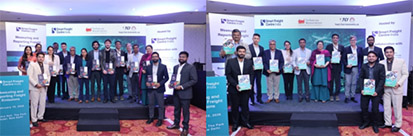
TUGD at the event on freight emissions accounting and reporting
|
| |
| TUGD participates in UNEP’s National Workshop on Fuel Economy Standards Implementation Roadmap in Viet Nam |
|
TUGD participated in the National Workshop on the Fuel Economy Standards Implementation Roadmap in Viet Nam, organized by the United Nations Environment Programme (UNEP). The workshop was held on 25 March 2026 in a hybrid format, with Mr Sharif Qamar, Associate Director, TERI, delivering a presentation on India’s experience in developing and implementing fuel-economy standards and associated policy frameworks.
During the session, he highlighted India’s approach to Corporate Average Fuel Economy (CAFE) standards for light-duty vehicles, policy design considerations, implementation mechanisms, and lessons for developing robust monitoring, reporting, and verification (MRV) systems. TERI’s experience provided insights to support Viet Nam as it moves towards operationalizing its fuel economy standards for light-duty vehicles as well as motorcycles and mopeds.
|
| |
| TUGD Engages in Capacity-Building Programme on Electric Mobility in Jammu |
|
TUGD participated in a three-day training programme on Urban Green Mobility, Electric Bus Ecosystems & Green Fuel Technologies: Policies, Infrastructure & Sustainable Transition Strategies, held from 11–13 February 2026 in Jammu. The programme was organised by Indian Institute for Human Settlements with support from Ministry of Road Transport and Highways and brought together senior and mid-level officials from transport corporations and government departments across India.
The training focused on key aspects of electric mobility, including EV technologies, policy frameworks, infrastructure planning, and implementation strategies, with the aim of supporting informed decision-making and accelerating the transition to sustainable transport systems.
Ms Viral Joshi, Associate Fellow, TERI contributed to two technical sessions: “Electric Vehicle Adoption in India and Fleet Management for E-Buses” and “Skilling for an EV-Ready India: A Roadmap to 2047.” These sessions drew on TERI’s extensive work on EV adoption and workforce development, offering practical insights into transition pathways, service optimisation strategies, and the potential for emissions reduction and cost savings.
Designed to be both informative and application-oriented, the sessions helped strengthen participants’ understanding of operational challenges, infrastructure requirements, and the broader ecosystem needed to support large-scale EV adoption in India.
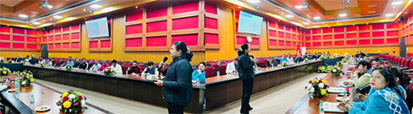
TUGD at training programme on Urban Green Mobility, Electric Bus Ecosystems & Green Fuel Technologies: Policies, Infrastructure & Sustainable Transition Strategies
|
| |
| TUGD Participates in National Workshop on Promoting Micromobility through Electric Bicycles |
|
TUGD participated as a project partner in the National Workshop on “Electric Bicycles Powering Rural Livelihoods – Promoting Micromobility through Electric Bicycles”, organised by the Ministry of Rural Development (MoRD) in collaboration with Convergence Energy Services Limited (CESL) and Energy Efficiency Services Limited (EESL) on 16 March 2026 at Bharat Mandapam, New Delhi. The workshop brought together government officials, implementation partners, and sector stakeholders to deliberate on scaling sustainable and inclusive mobility solutions in rural India.
The workshop built upon learnings from the STREE (Sustainable Transport for Rural Entrepreneurs through Electric Bicycles) initiative, implemented across multiple states including Bihar, Kerala, Andhra Pradesh, and Madhya Pradesh. As part of this initiative, TUGD contributed to the impact assessment of e-cycles deployed in Bihar, examining their role in improving access to education and livelihoods, reducing travel time and physical effort, and enabling greater mobility for women beneficiaries.
Key discussions during the workshop focused on policy support mechanisms, financing models, and strategies for scaling electric micromobility solutions in rural contexts. Stakeholders highlighted the importance of strengthening ecosystem support, including capacity building, community mobilisation, and integration of mobility solutions with livelihood programmes. The STREE Impact Assessment Report was formally launched during the event, and TERI was recognised for its contribution to assessing the socio-economic and environmental impacts of the initiative. The workshop underscored the potential of electric bicycles as a low-cost, low-carbon mobility solution and highlighted the need for coordinated action across government, industry, and development partners to scale such interventions and strengthen rural economies.
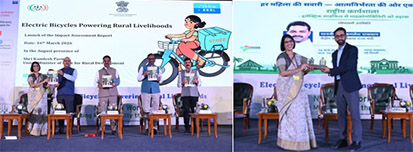
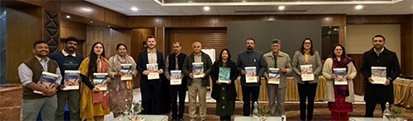
TUGD participated as a project partner in the National Workshop on “Promoting Micromobility through Electric Bicycles”
|
| |
| TUGD Contributes to MEA-ITEC Training Programme on Electric Mobility |
|
TUGD contributed to a five-day training programme on Electric Vehicles, Batteries, and Charging Infrastructure organised under the Ministry of External Affairs (MEA)’s Indian Technical and Economic Cooperation (ITEC) capacity-building platform at NTPC School of Business, Noida, on 2 January 2026. Mr Sharif Qamar, Associate Director, TERI, delivered an expert session on the “Global Industrial Outlook of EVs.” The programme brought together around 25 international officials from countries including Bhutan, Botswana, Cambodia, Ethiopia, Fiji, Ghana, Kenya, Morocco, Oman, Sri Lanka, Tanzania, and Thailand. The session provided insights into global industry trends, emerging technologies, and market dynamics shaping the electric mobility transition.
|
| |
| TUGD Contributes to Panel Discussion on Clean Mobility Transition |
|
TUGD participated in a panel discussion organised by Climate Policy Initiative (CPI) on “Driving Jobs, Economic Growth, and Climate Action: The Role of Clean Mobility in India” on 23 March 2026. Mr Sharif Qamar, Associate Director, TERI, was invited as a panellist for the event, which was organised in the context of India’s accelerating transition towards clean mobility, driven by national priorities related to climate action, energy security, air quality improvement, and industrial competitiveness.
The panel brought together experts from policy, industry, finance, and research institutions to deliberate on how India can maximise the economic and employment potential of the clean mobility transition. Discussions focused on emerging opportunities across electric vehicle manufacturing charging infrastructure, and clean logistics, as well as the need for coordinated policy and investment frameworks to support an inclusive transition.
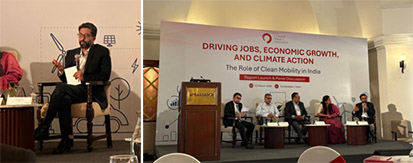
TUGD participated in “Driving Jobs, Economic Growth, and Climate Action: The Role of Clean Mobility in India” by CPI.
|
| |
| TUGD Contributes to International Training Programme on Sustainable Urban Mobility |
|
TUGD participated in a two-week international training programme on “Towards Sustainable Urban Mobility in Developing Urban Contexts”, organised by Human Settlement Management Institute, the research and training wing of Housing and Urban Development Corporation Limited. The programme was held from 11–24 March 2026 and sponsored by the Ministry of External Affairs under the Indian Technical and Economic Cooperation Programme, bringing together international professionals working in the urban sector.
On 19 March 2026, Ms Viral Joshi, Associate Fellow, delivered two technical sessions focused on advancing sustainable urban transport systems. The first session, “Sustainable Urban Transport: Emissions Assessment and Reduction Strategies,” covered key emission accounting frameworks, including the types of datasets required, sources of data, and commonly used methodologies for estimating transport emissions. The discussion also highlighted practical challenges in data availability and ways to strengthen evidence-based planning.
The second session, “Advancing Sustainable Mobility through Low-Carbon Transition,” focused on India’s progress in accelerating electric vehicle adoption. It explored the role of national and state-level policies, institutional coordination, and collaborative approaches in enabling this transition. The session also addressed common myths and concerns around EVs, helping participants better understand their operational, environmental, and economic implications.
The sessions aimed to build practical understanding among participants and support informed decision-making for advancing low-carbon and sustainable urban mobility in developing country contexts.
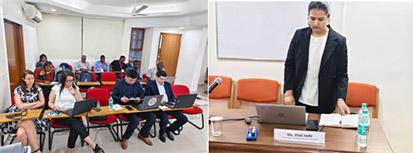
TUGD at international training programme on “Towards Sustainable Urban Mobility in Developing Urban Contexts”
|
| |
| TUGD Contributes to Dialogue on Green and Tech-Enabled Supply Chains at PHDCCI Seminar |
|
TUGD participated in the seminar on “E-Commerce Logistics 2026: Leveraging AI & Automation for Next-Gen Supply Chains,” organised by PHD Chamber of Commerce & Industry on 27 March 2026 in New Delhi.
In the inaugural session, I. V. Rao, Distinguished Fellow at The Energy and Resources Institute, highlighted the growing role of AI in e-commerce logistics. He discussed its applications across demand forecasting, smart warehousing, route optimisation, last-mile delivery, and reverse logistics, along with overall impacts such as reduced costs, improved efficiency, and faster deliveries.
In Session II on “Green & Sustainable Supply Chains,” Viral Joshi, Associate Fellow, TUGD, spoke on the role of electric vehicles (EVs) in enabling sustainable logistics. The session highlighted the environmental and economic benefits of EV adoption, with TCO trends increasingly favouring electrification. Insights from TERI’s work, including studies with India Post and the Naroda GIDC cluster, were also shared to illustrate practical learnings for scaling up green logistics.
The seminar provided a useful platform to bring together perspectives on technology and sustainability for the future of supply chains.
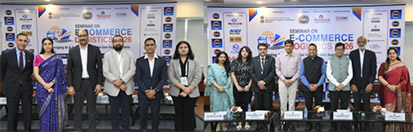
TUGD at the seminar on “E-Commerce Logistics 2026: Leveraging AI & Automation for Next-Gen Supply Chains,”
|
| |
| TUGD Participates in Panel Discussion on Building India’s EV Workforce |
|
TUGD participated in a panel discussion organised by RMI and Shoonya on “Building India’s EV Workforce: Skilling, Reskilling, and Capacity Building for an Inclusive Transition” on 24 March 2026. Mr Sharif Qamar, Associate Director, TERI, was invited as a panellist for the session. The discussion focused on the evolving workforce requirements emerging from India’s transition to electric mobility, highlighting the need for targeted skilling, reskilling, and institutional capacity building. Deliberations emphasised aligning training systems with industry needs and ensuring an inclusive approach to workforce transformation as the EV ecosystem expands. The discussion also examined challenges related to shifting labour dynamics within traditional internal combustion engine (ICE) supply chains and emphasised the importance of proactive workforce adaptation strategies.
|
| |
| TUGD Participates in CivicSabha 2.0 on AI for Climate |
|
TUGD participated in CivicSabha 2.0, a roundtable on AI for Climate organised by CivicDataLab on 12 February 2026 at the Dr Ambedkar International Centre, New Delhi. The event brought together policymakers, technologists, researchers, civil society organisations, and practitioners working at the intersection of data, technology, and public systems.
The session focused on fostering cross-sector collaboration and explored applications of AI in climate and urban planning, including flood-resilient infrastructure, agricultural advisories, and livelihood protection. Discussions also examined how vulnerability data layers can be integrated into AI systems to enable informed, equitable, and timely decision-making.
|
| |
| TUGD Participates in the Second National Convention on Women in India at O.P. Jindal Global University |
|
TUGD participated in the Second National Convention on Women in India and the Jindal Interdisciplinary Arts and Literature Festival held at O.P. Jindal Global University, Sonipat, on 20 March 2026. Ms Shiren Pandita, Associate Fellow, TERI, was invited as a speaker in the panel discussion titled “Mainstreaming Gender: Conservation, Sustainability and Climate Action.” The session brought together experts and practitioners to deliberate on the integration of gender perspectives within climate policy and sustainability frameworks. During the discussion, she highlighted the need to move beyond policy intent and ensure that gender mainstreaming is reflected in institutional processes, including budgeting, leadership representation, and measurable outcomes. The engagement contributed to advancing discourse on inclusive and equitable approaches to climate action and sustainable development.

TUGD at the Second National Convention on Women in India
|
| |
| TUGD Delivers Lecture on Urban Living Labs at TERI SAS University |
|
TUGD delivered a lecture on Urban Living Labs: A New Initiative in Climate Resilient Planning at TERI School of Advanced Studies on 20 March 2026. The session was conducted as part of the Policy Lab-II course under the MA - Public Policy and Sustainable Development programme.
The lecture introduced the concept of urban living labs as platforms for participatory, data-driven, and experimental approaches to urban planning. It highlighted their role in enabling collaboration between government agencies, researchers, communities, and private sector stakeholders to co-create solutions for complex urban challenges.
The session also explored the application of living labs in advancing climate-resilient planning, including their potential to support pilot interventions, test innovative solutions, and generate evidence for scaling successful approaches. The engagement provided students with practical insights into emerging planning approaches and reinforced the importance of collaborative and adaptive frameworks in addressing urban sustainability challenges.
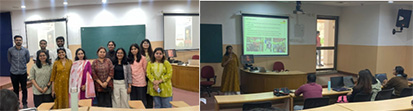
TUGD delivered a lecture on Urban Living Labs: A New Initiative in Climate Resilient Planning at TERI School of Advanced Studies
|
| |
| TUGD Conducts Site Visits to CONCOR Facilities for Freight Assessment |
|
TUGD conducted site visits to Inland Container Depot (ICD) Tughlakabad and Kadipur (near Alipur) on 6 January 2026 to assess the feasibility of deploying electric trucks between the Alipur cluster and ICD Tughlakabad. The visits included truck driver surveys to evaluate operational characteristics (such as loading and unloading time), en-route characteristics (including speed and route conditions), as well as traffic and road conditions.
The TERI team, along with CONCOR officials, also conducted a follow-up visit to ICD Tughlakabad on 3 February 2026 to gain a better understanding of reefer container operations and to collect data for refining the ongoing analysis.
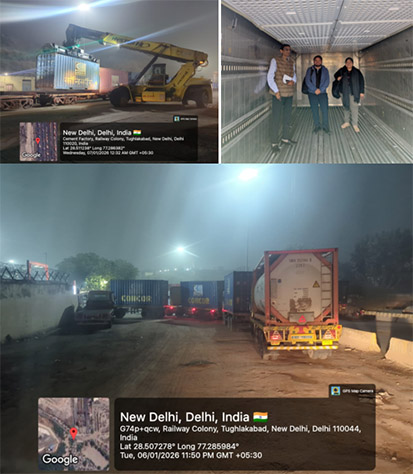
TUGD Conducted Site Visits to ICD Tughlakabad and Kadipur
|
| |
| TUGD Conducts Field Visits under India Post RTN Study |
|
TUGD conducted field visits across the Rajasthan circle of India Post between January and March 2026 as part of the ongoing study on the Road Transport Network (RTN) of India Post. The visits focused on understanding operational dynamics, route structures, and logistics processes within the network. The study aims to analyse existing routing systems to optimise route efficiency and assess opportunities for electrification across RTN operations. Field-level insights are being leveraged to identify logistical challenges and evaluate routes best suited for EV integration.
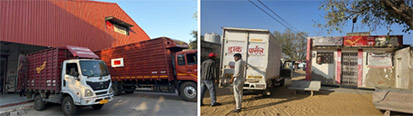
TUGD Conducted Site Visits to Rajasthan circle for the India Post RTN study
|
| |
|