


News, Views, and Updates from TERI


Dear Reader,
February was a whirlwind of progress and a true landmark month for all of us at TERI. The undisputed highlight was the 25th silver jubilee edition of the World Sustainable Development Summit, held from February 25–27 at the Taj Palace, New Delhi. Hosting over 2,000 global delegates, this milestone event not only celebrated our past achievements but also solidified WSDS as a premier platform for shaping a greener future.
Beyond the summit, our research divisions remained exceptionally active, forging new paths through several MoUs and collaborative partnerships. This flurry of activity has created an incredible momentum that we are eager to carry forward in March 2026.
World Sustainable Development Summit 2026

The silver jubilee edition of the World Sustainable Development Summit (WSDS) 2026—the annual flagship platform of The Energy and Resources Institute (TERI)—successfully concluded at the Taj Palace. This landmark event served as a high-level convergence for global leaders, policymakers, industry captains, and civil society, all focused on advancing a rigorous agenda for transformative climate and development action. Operating under the theme “परिवर्तन | Transformations: Vision, Voices and Values for Sustainable Development,” this 25th anniversary edition solidified the Summit's legacy. It remains a unique milestone as the only independently convened international platform for sustainable development rooted in the Global South, bridging the gap between visionary ideas and tangible global impact.
Know MoreHim CONNECT

Hosted by the MoEFCC and TERI during WSDS 2026, Him-CONNECT successfully bridged the gap between Himalayan scientific research and commercial scalability. The two-day event showcased market-ready innovations from the National Mission on Himalayan Studies (NMHS)—including patents and prototypes for water security and waste management—directly to start-ups and investors. By fostering these critical industry-investor synergies, the initiative paved the way for deploying climate-resilient technologies across the Indian Himalayan Region.
Know MoreCEO Forum
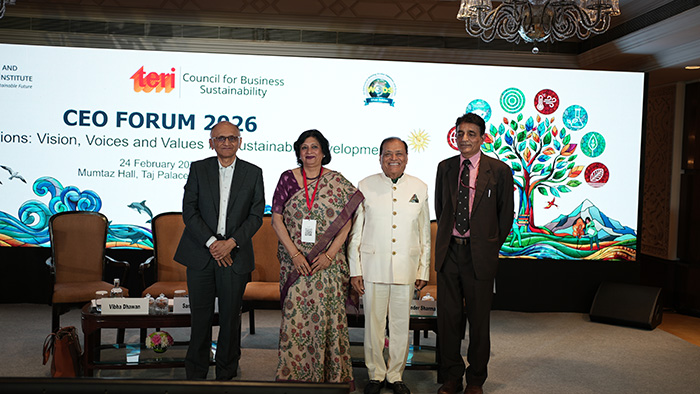
At a defining moment for global and national climate action, the CEO Forum 2026 — convened by TERI on 24th February, 2026, as part of the Silver Jubilee edition of the World Sustainable Development Summit (WSDS) — brought together leading voices from business, finance, industry, and policy under the theme: “परिवर्तन | Transformations: Vision, Voices, and Values for Sustainable Development”. This year’s CEO Forum moved beyond incremental sustainability conversations to focus squarely on systemic transformation — and the role of corporate leadership in driving it.
Know MoreTERI's LaBL 2.0 Launched

At a defining moment in India’s clean energy transition, TERI launched LaBL 2.0 (Lighting a Billion Lives 2.0) during WSDS 2026, at an inspiring ‘Dinner of Hope’ in New Delhi — reimagining decentralized renewable energy as a catalyst for green livelihoods, women-led entrepreneurship, and measurable climate action. Building on the transformative success of TERI’s original Lighting a Billion Lives initiative — which demonstrated how decentralized renewable energy (DRE) can empower communities — LaBL 2.0 moves beyond energy access to enable, Large-scale productive use of decentralised renewable energy, Green livelihoods and women-led enterprises, Strengthened local clean energy value chains, Robust carbon accounting and climate outcome measurement, and Scalable, replicable, and finance-ready implementation models.
Know More
LABL2.0 Website and Logo Unveiled
The launch of the LABL2.O also featured the unveiling of the LaBL 2.0 Mission & Vision, the programme logo, digital platform, and the premiere of the LaBL 2.0 Vision Film — setting the tone for a transition that is inclusive, accountable, and financially sustainable.
Know More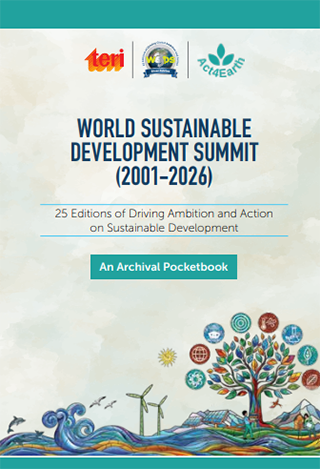
WSDS 2001-2026 An Archival Pocketbook
Commemorating twenty-five editions of the World Sustainable Development Summit, an Archival Pocketbook capturing the Summit’s remarkable journey was launched at the Inaugural Session of WSDS 2026. It documents how sustained dialogue and evidence-based engagement have influenced international sustainability discourse and policy making. Marking the Summit’s Silver Jubilee, the publication reflects on collective milestones while underscoring the need to convert shared commitments into tangible action.
Know More
India Sketch Summary
The ‘India Sketch of Energy Transition to 2050’ provides a strategic framework for navigating the complexities of the mid-century energy landscape. Rather than predicting a single outcome, the report analyzes three distinct global trajectories: Surge, defined by AI-driven economic acceleration; Archipelagos, a landscape of fragmented trade and self-reliance; and Horizon, a normative pathway aligned with global Net Zero goals.
Know More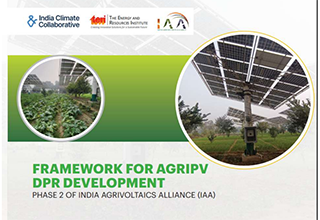
Framework for AgriPV DPR Development
This framework provides a structured approach to AgriPV development through five interconnected dimensions—from initial site assessment to postinstallation operations. This wireframe enables stakeholders to make informed decisions across technical, financial, social, and governance aspects while ensuring agricultural productivity remains central to system design.
Know More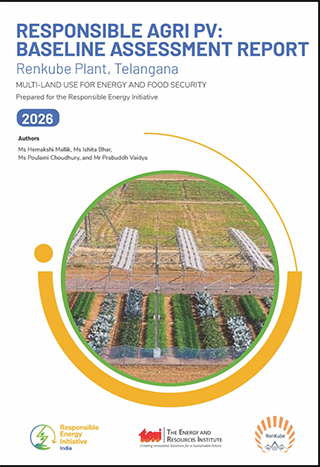
Responsible AGRI PV: Baseline Assessment Report, Renkube Plant, Telangana
This baseline report, developed under Pillar 2 of the Renewable Energy Initiative (REI) on People-Centric Business Models, evaluates the performance of the Renkube Agri-PV pilot in Telangana, was launched during the WSDS 2026. Conducted in partnership with PJTSAU and Renkube Pvt. Ltd., the study utilizes multi-season field data to assess energy yields, crop responses, and financial viability within local agro-climatic conditions.
Know More
AgriPV-Potenital-in-India: Pathways for Sustainable Energy-Food Solutions
This GIS-based study identifies a transformative national AgriPV potential of up to 2,129 GW, concentrated largely in six states, offering a strategic solution to India’s dual challenges of surging energy demand and limited land availability. By aligning solar expansion with high-value horticultural crop production, the report provides a scalable, evidence-based roadmap for integrating climate-resilient energy into the agricultural landscape without compromising food security.
Know More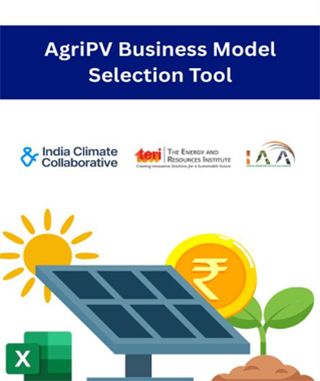
AgriPV Business Model Selection Tool
The AgriPV Business Model Selection Tool, developed by TERI is a decision-support platform designed to help stakeholders identify the most suitable ownership and financing structure for Agrivoltaics (AgriPV) projects. This tool enables farmers, developers, FPOs, and policymakers to compare alternative business models and assess their financial feasibility in a transparent and structured manner.
Know More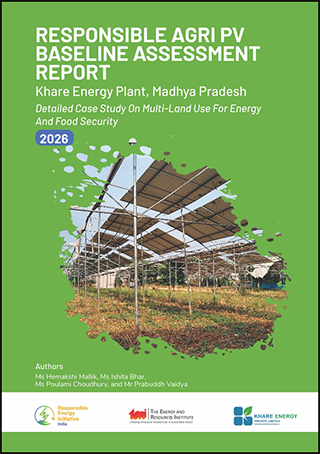
Responsible AGRI PV: Baseline Assessment Report, Khare Energy Plant, Madhya Pradesh
Developed under the Responsible Energy Initiative’s (REI) focus on people-centric business models, this baseline report evaluates a farmer-led Agri-PV pilot in Madhya Pradesh’s Bundelkhand region to assess its impact on energy performance, crop yields, and socio-economic resilience. The findings provide a practical roadmap for stakeholders to scale dual land-use models that prioritize farmer-centric design, affordable financing, and the alignment of renewable energy goals with local agricultural livelihoods.
Know More
The Politics of Sustainable Development
Launched during the Valedictory Session of WSDS 2026, The Politics of Sustainable Development offers a unique look at Chairman Nitin Desai’s pivotal role within the Brundtland Commission and the United Nations. Written as a personal memoir rather than a technical exposition, the book is divided into two parts: the first provides a retrospective look at the two-decade evolution of the global consensus on sustainability, while the second offers a firsthand account of Desai’s perspective during his tenure in various leadership capacities.
Know More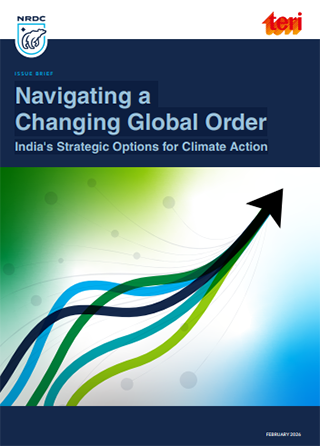
Navigating a Changing Global Order India's Strategic Options for Climate Action
Amidst a fracturing global climate regime and the United States' withdrawal from the UNFCCC, this publication, launched during WSDS 2026, explores how India can navigate a transition increasingly defined by trade-linked climate clubs rather than traditional multilateralism. It argues that by leveraging its development-centric model—focused on energy security, competitive solar auctions, and green hydrogen—India can defend the principles of equity while positioning itself as a strategic leader for the Global South in an uncertain international order.
Know More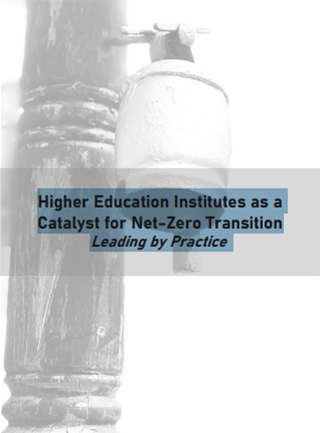
Higher Education Institutes as a Catalyst for Net-Zero Transition Leading by Practice
This case compendium, ‘Higher Education Institutes as a Catalyst for Net-Zero Transition: Leading by Practice’, serves as a practical resource documenting how institutions are translating carbon-neutral ambitions into reality through technology, governance, and curriculum integration. By showcasing sixteen diverse institutional exemplars, the publication provides a structured evidence base for peer learning and scalable action, positioning higher education as a critical cornerstone in India’s national decarbonization journey.
Know More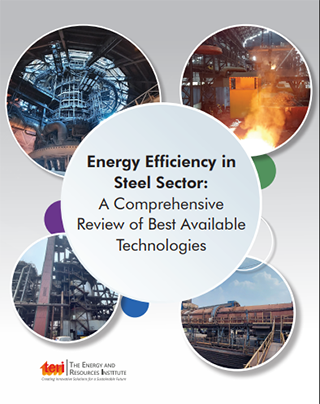
Energy Efficiency in Steel Sector: A Comprehensive Review of Best Available Technologies
Building on TERI’s long-standing work on industrial decarbonisation and resource efficiency, this publication evaluates the potential of (BATs) to enhance plant-level performance—highlighting how wider adoption could, in aggregate, enable up to a twofold improvement in energy efficiency across major production routes. The report assesses capital costs, payback periods, and quantified energy savings for BAT options across BF–BOF, DRI–EAF/IF, and downstream processing routes.
Know More
Clean Freight Program: Baseline Study (Phase-II)
The study builds upon the experiences of the Perform, Achieve and Trade (PAT) scheme and aligns with the Carbon Credit Trading Scheme (CCTS) notified in 2023, which plans to include the transport sector in future. A methodological framework was developed to identify priority sectors with substantial freight demand and emissions impact.
Know MoreTERI and GCC sign an MOU for India’s First Digital Carbon Marketplace
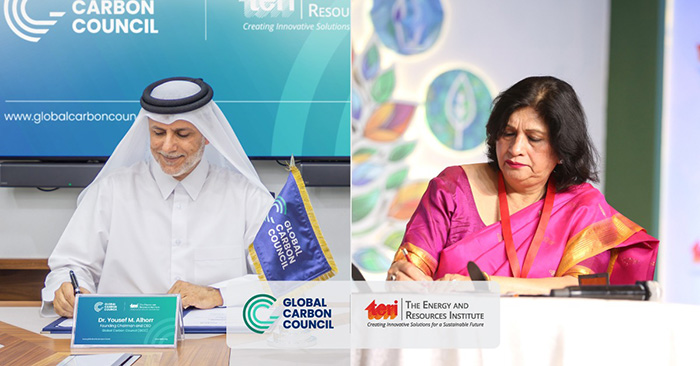
The Global Carbon Council (GCC), the first internationally accredited carbon standard in the Global South and TERI, signed a landmark Memorandum of Understanding (MoU) to establish India’s first digital carbon marketplace for household and livelihood-based clean energy projects under TERI’s flagship LaBL 2.0 – Lighting a Billion Livelihoods.
Know MoreTERI Leads Push for Regional Energy Transition Hub in Eastern & North-East India
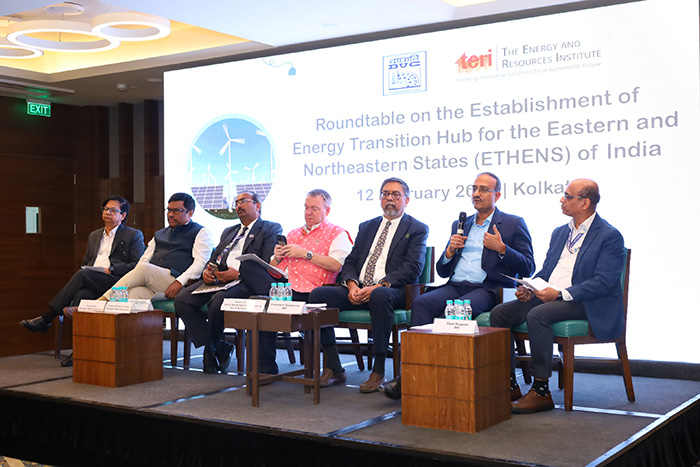
TERI convened senior policymakers, distribution companies (DISCOMs), regulators and energy leaders in Kolkata on February 12, 2026 to deliberate on the establishment of the Energy Transition Hub for the Eastern and Northeastern States (ETHENS) of India. Supported by the Damodar Valley Corporation (DVC), the proposed Hub is envisaged as a DISCOM-driven, demand-led regional platform to accelerate a balanced, resilient and region-specific energy transition. The high-level roundtable focused on designing ETHENS as a permanent institutional mechanism that can help utilities in the Eastern and North-Eastern states translate national clean energy ambitions into implementable, utility-centric actions.
Know MoreFrom Data to Decarbonisation: SFC–TERI Whitepaper Anchors India’s Freight Emissions Accounting
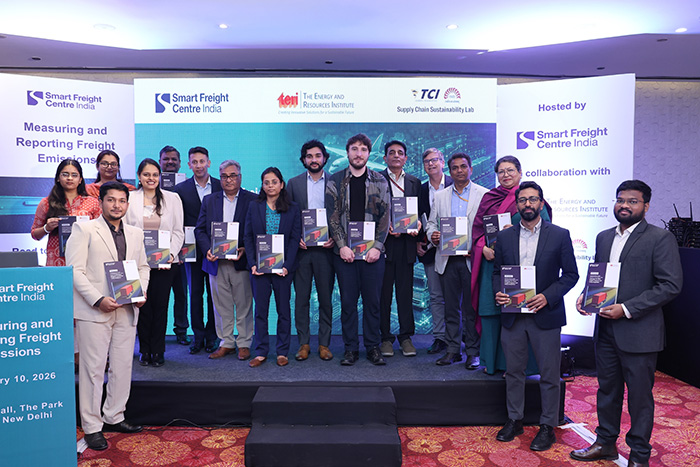
Smart Freight Centre (SFC) India, in collaboration with The Energy and Resources Institute (TERI) and IIM-Bangalore, released a Whitepaper titled, Institutionalizing Freight Emissions Accounting in India: Pathways for Clean Freight Programs and Policy Integration at the high-level convening, “Road to Zero Emissions: Measuring and Reporting Freight Emissions”, held in New Delhi.
Know MoreCrops may fail, solar will not: Climate-resilient agriculture for a new India
Feeding a population as large as India’s is no simple ecological equation. It is a complex technological, economic, and governance challenge. It is a challenge that now demands systemic rethinking writes Dr Vibha Dhawan, Director General, The Energy and Resources Institute (TERI).
Know More
From budget provision to national capability: Why India’s CCUS commitment matters
CCUS enters India’s decarbonisation landscape as a complementary solution. It offers a pathway to extend asset life while reducing environmental impact. These issues will find deeper reflection at the WSDS 2026, to be held from 25–27 February in New Delhi writes Mr Mahendra Singhi, Member Governing Council, TERI & Mr Anupam Badola, Deputy CSO and General Manager, Dalmia Cement (Bharat) Limited.
Know More
We need to underline value of collaboration on climate change
In a world where the US has exited many major international treaties and decided to walk away from its commitment to protect climate, multilateralism is clearly under great stress writes Mr R R Rashmi, Distinguished Fellow & Programme Director, Resource Efficiency & Governance Division.
Know More
Why India Must Recognise Climate Investments as a Distinct Financing Category
India needs a commercial finance ecosystem that treats climate risk as financial risk and equips lenders to reflect the realities of a warming world writes Ms Leena Nandan, Distinguished Fellow and Mr Sidharth Sinha, Senior Fellow, Earth Science and Climate Change Division, The Energy and Resources Institute (TERI).
Wetlands and Peatlands: India’s Overlooked Carbon Opportunity
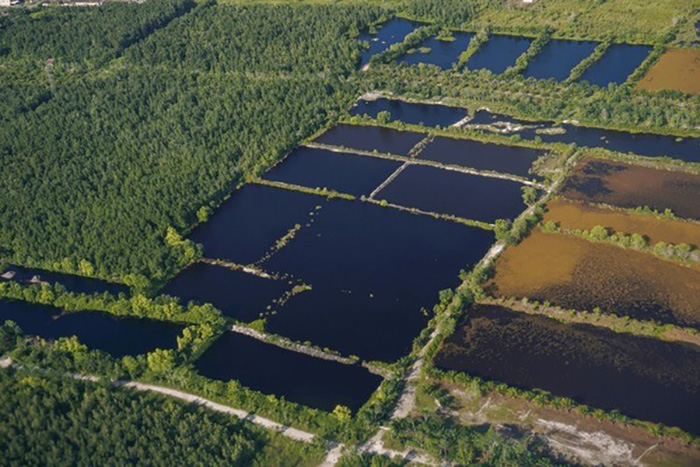
India has no shortage of wetlands. National assessments indicate that wetlands cover over 15 million hectares, cutting across floodplains, high-altitude lakes, mangroves, lagoons, marshes, and urban water bodies. Yet these landscapes are among the most degraded ecosystems in the country, write Mr Jitendra Vir Sharma and Mr Sayanta Ghosh on their article for the TERI WebDesk.
View AllTAKE 3
Take 3 is a short video featuring in-house experts who answer three pertinent questions on current issues.
TAKE 3: Shaping a Greener Future: WSDS 2026
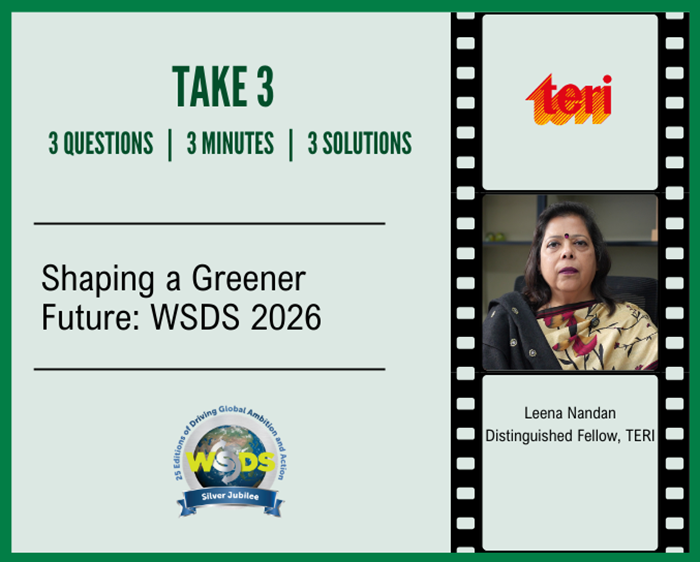
As we approach the Silver Jubilee edition of the World Sustainable Development Summit, the countdown to #WSDS2026 has officially begun. In this special edition of TAKE 3, we are joined by Ms Leena Nandan, Distinguished Fellow, TERI, as she delves into the legacy of WSDS and the roadmap for the upcoming summit. From driving Parivartan (Transformation) to amplifying the voices of the Global South, WSDS 2026 is set to be a definitive moment for the global climate discourse. Watch the full video to explore the vision, voices, and values that will define our collective climate action this year.
Watch HereTAKE 3: The ₹20,000 Crore Bet: Why Budget 2026 is All-In on CCUS
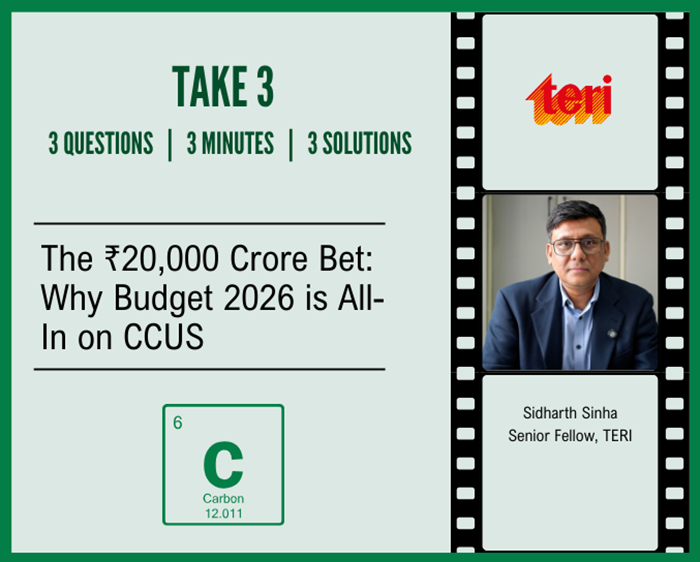
As India’s 2026 Budget pivots toward CCUS, the conversation has shifted from ‘if’ to ‘how much.’ In this post-Budget special edition of TAKE 3, Sidharth Sinha, Senior Fellow, TERI, breaks down the fiscal logic behind the government’s massive bet on Carbon Capture—and what it means for the future of Indian industry and the common citizen.
Watch HereWorld Sustainable Development Summit 2026
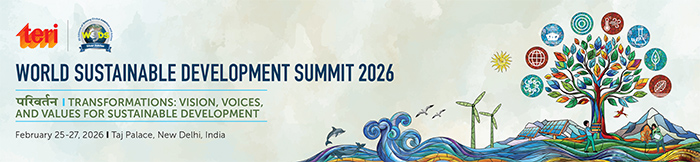
The 2026 edition of WSDS marked the Silver Jubilee of the Summit. This 25th edition of the milestone event was held from 25–27 February 2026 at the Taj Palace, New Delhi, under the umbrella theme: परिवर्तन | Transformations : Vision, Voices, and Values for Sustainable Development.
Watch HereTERI (The Energy and Resources Institute)
Darbari Seth Block, Core 6C, India Habitat Centre, Lodhi Road,
New Delhi - 110 003, INDIA
Tel. : (+91 11) 2468 2100, 7110 2100
E-mail : mailbox@teri.res.in